
Building Reliable and Resilient Power Grid Through SANPEC Excellence Model
Introduction
The July 2025 floods in the Kerr County, Texas was a tragic event with loss of human life and widespread economic damage, including to power grid infrastructure along the Guadalupe River. Texas also faced widespread power outages in August 2024 with over one million homes experiencing electricity disruptions. In February 2021, winter storms caused blackouts and power disruptions for several days impacting more than 4.5
million homes and businesses in Texas. Apart from natural hazards and extreme weather events, technological failures such as an aging grid infrastructure, equipment failure and cybersecurity threats add to emerging systemic risks to power grid infrastructure.
Need for resilient electricity infrastructure
While loss of human life is irrecoverable, we can and must take steps to strengthen the resilience of electricity transmission lines and power substations so that they withstand natural calamities. Avoiding power loss and quick recovery can be lifesaving especially as prolonged outages coupled with flooding of back-up generators has a catastrophic impact on hospitals which need electricity to run critical equipment like ventilators, lab
devices, and HVAC systems. Several other key services such as communication, transportation systems, food, housing, and water are dependent on electricity and a damage to the electric grid may lead to spiraling economic impacts from lower productivity, loss of public trust in essential services and impacts on public safety.
Key elements of a resilient power system
A resilient power grid is one which withstands, responds to, and recovers rapidly from major power disruptions as its designers, planners, and operators anticipate, prepare for, and adapt to changing grid conditions. A resilient power grid also has high operational reliability and resource adequacy which allows it to supply sufficient electricity throughout the year. A resilient power system goes beyond being a passive
system which just keeps the lights on; Instead, it is a dynamic system that can absorb the shock of extreme events, limit the spread of a technical fault and can restore critical services with speed and efficiency, while also learning and adapting for future challenges.
Key characteristic of a resilient power system includes hardening of physical infrastructure to resist damage from anticipated threats by using more durable materials, better design and making critical components more robust to failures which reduces the likelihood of initial damage and the severity of disruptions when an event occurs. Examples include hardening power lines with stronger poles, use of strengthened conductors, underground cables and elevated substations. Building in diversity of supply sources and interconnections lowers reliance on single points of
failure.
Integration of digital communication, sensors, automated controls, and data analytics to monitor, control, and optimize grid operations in real-time enables faster detection and isolation of faults, allows self-healing though automatic rerouting of power, predictive maintenance, and optimized response during emergencies. Higher redundancy and spare capacity enable multiple pathways for power delivery and the ability to quickly
reconfigure the grid or deploy mobile assets to restore service allows greater flexibility for grid operation. Robust measures to protect critical control systems, data, and physical assets from cyberattacks are also essential to prevent disruption of grid operations. Proactive planning and adaptive management measures include regular risk assessment through stress testing and developing scenarios for high-impact events, integrating learnings from past events, and having detailed recovery plans. This results in better preparedness, reduced recovery times, and strategic investment in grid assets.
Enhancing grid resilience through SANPEC’s Business Excellence Model; SANPEC is strengthening America’s electricity grid infrastructure and transforming it to become resilient, modern and high-performing energy infrastructure using advanced engineering solutions, cutting-edge technologies, and smarter system operations.
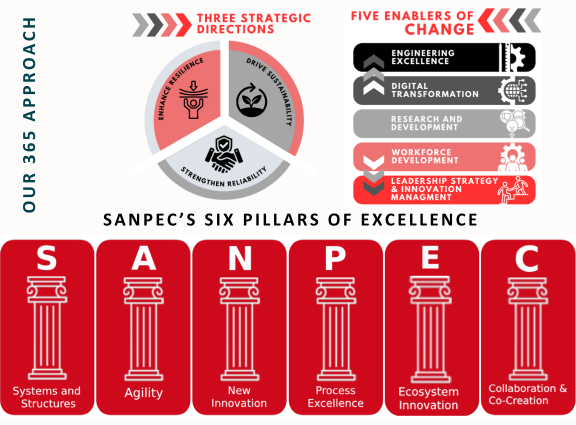
SANPEC’s Six Pillars of Business Excellence Model provide a strong foundation to enhancing resilience, strengthening reliability and drives sustainability.
a) A Systems Approach to design integrates all components of energy infrastructure holistically and emphasizes interdependencies over isolated functions for better resilience and optimization.
b) Agility enables rapid adaptation to changing market conditions, regulations, and evolving technology, thereby supporting operational flexibility and
responsiveness.
c) New Innovation focuses on integrating cutting-edge R&D to address industry challenges and continuous improvements through strategic partnerships.
d) Process Excellence prioritizes operational efficiency, quality management, and optimizes processes from design to execution.
e) Ecosystem Innovation builds collaborative ecosystems involving suppliers, customers, and industry leaders while driving shared innovation and value creation.
f) Collaboration & Co-Creation allows active engagement with local communities, stakeholders, and policymakers through inclusive partnerships.
The Road Ahead:
a) Modernize and Harden Core Infrastructure: SANPEC is rethinking transmission engineering and is at the forefront of grid and distribution networks hardening, implementing load adaptive grid expansion, developing modular and adaptive designs to enhance long-term system reliability and resilience.
b) Policy and Regulatory Support: There is a need for clear policies, incentives for investment in resilience, and updated regulations. SANPEC is a strong advocate for implementing supportive regulatory frameworks and mechanisms for hardening and modernization grid infrastructure projects
c) Implementing risk management approaches: ISO 31000 is an internationally recognized standard which offers a framework for integrating risk management into organizational processes and promotes a systematic approach to identifying, assessing, and treating risks. SANPEC supports its implementation in public and private utilities to enable them to make informed decisions in the case of a crisis.
d) Public-Private Partnerships for Research & Development: Government, utilities, tech companies, and research institutions must collaborate to develop solutions for next-generation grid technologies, advanced materials, and cybersecurity solutions. SANPEC is advancing innovation through collaboration with several universities such as the Gonzaga University where it is a founding member of the Master of Engineering Program in Transmission and Distribution Engineering
e) Public Awareness and Community Engagement: Educating the public and stakeholders on the importance of grid resilience fosters community buy-in and preparedness. SANPEC is engaging with the community through regular interactions to create awareness and engagement through the strategic alliances.
Conclusion
A resilient power grid is a necessity as it serves as a foundation for economic stability, energy security, industrial growth, economic development and safety. SANPEC with its relentless commitment to innovation and excellence is designing, modernizing, and managing resilient power transmission and distribution grids. This will contribute to future proofing energy services by shaping a resilient grid infrastructure that will power generations to come.